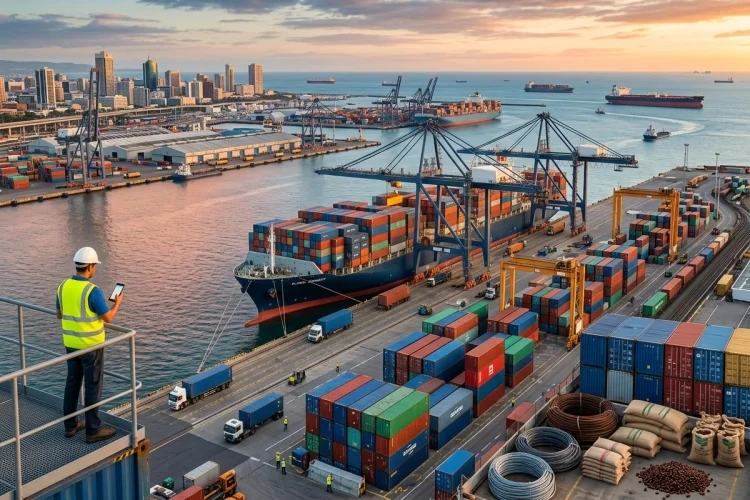
Look around your home and you will probably find products connected to several countries. Your phone may have been designed in one place, assembled somewhere else, and built with components sourced from multiple continents.
The coffee in your kitchen, the fuel used by your car, and the clothes in your wardrobe may also have crossed national borders.
So, why do countries trade with each other instead of producing everything themselves?
International trade allows nations to buy goods and services that would be expensive, difficult, or impossible to produce domestically. It also gives businesses access to larger markets and enables countries to specialise in activities where they have a relative advantage.
Trade can increase productivity, broaden consumer choice, and support economic development. However, the benefits are not always distributed equally. Some industries expand, while others face stronger foreign competition.
Understanding why countries trade helps explain imports, exports, tariffs, global supply chains, and many of the products we use every day.
What Is International Trade?
International trade is the exchange of goods and services between countries. Products sold to another country are called exports, while products purchased from abroad are called imports.
Exports can include physical goods such as coffee, cars, machinery, and clothing. Services are also traded internationally, including tourism, banking, transport, software development, consulting, education, and entertainment.
A country may export agricultural products while importing medical equipment. Another may sell financial services abroad and buy energy, food, or manufactured components from international suppliers.
Trade allows each economy to connect its workers, natural resources, technology, and businesses with global demand. The World Bank describes trade as an important source of economic opportunity, job creation, productivity growth, and poverty reduction.
Countries Have Different Resources and Conditions
Countries trade partly because they do not have the same natural resources, climate, workforce, technology, or geographical conditions.
A tropical country may be well suited to growing coffee, bananas, or cocoa. A country with large oil reserves can produce petroleum more easily than one without accessible deposits.
Coastal nations may develop strong fishing or shipping industries, while countries with highly educated workforces may specialise in advanced services.
Climate also affects what can be produced efficiently. Growing tropical fruit in a cold country may require expensive greenhouses, artificial lighting, and heating. Importing the fruit from a warmer region may use fewer resources.
Differences in capital and technology matter too. Countries with advanced machinery and research institutions may be especially competitive in pharmaceuticals, aircraft, or electronics. Labour-abundant economies may initially specialise in industries requiring large workforces.
Trade allows countries to access resources and products that are unavailable or costly to produce at home.
Comparative Advantage Encourages Specialisation
The most important economic explanation for international trade is comparative advantage.
Comparative advantage means a country can produce a good or service at a lower opportunity cost than another country. Opportunity cost is the value of the best alternative given up when resources are used for one activity.
A country does not have to be the world’s best producer to benefit from trade. Even when one nation is more productive in every industry, both countries may gain by specialising according to their relative strengths.
The WTO and IMF identify this principle as a central reason countries can benefit from international exchange.
Imagine two countries that produce rice and computers. Country A is highly efficient at both, but its advantage is especially large in computer production. Country B is less productive overall, but it gives up fewer resources when producing rice.
Country A can focus more heavily on computers, while Country B produces more rice. By trading, both may obtain more rice and computers than they could achieve through complete self-sufficiency.
Specialisation Can Improve Productivity
Trade encourages countries and companies to concentrate on activities they perform relatively efficiently. This specialisation can raise productivity because resources are directed towards their most valuable uses.
A firm serving only a small domestic market may produce limited quantities at a high average cost. Access to international customers can allow it to expand production, invest in better equipment, and spread fixed expenses across more units.
This is known as an economy of scale. It helps explain why certain products, including aircraft, semiconductors, and specialised machinery, are often produced by a limited number of large international suppliers.
Trade also exposes domestic companies to foreign competition. Businesses may need to improve quality, adopt new technology, reduce waste, or develop better products to remain competitive.
The OECD notes that open and competitive markets can promote efficiency, innovation, technology adoption, lower prices, and greater consumer choice.
Trade Gives Consumers More Choice
Without international trade, consumers would be limited to what their own country could produce. Shops would offer fewer products, and many goods would be available only during particular seasons.
Imports give consumers access to different foods, clothing brands, vehicles, medicines, technologies, and entertainment.
A country can enjoy coffee without growing coffee beans, use smartphones without producing every component, and access specialised medical equipment made elsewhere.
Greater competition between domestic and foreign suppliers can also help control prices. When customers have more alternatives, businesses face pressure to offer reasonable prices and acceptable quality.
The effect is especially important when imported products are cheaper than domestic alternatives. Lower prices can increase households’ purchasing power, allowing them to buy more with the same income.
However, consumers may become vulnerable when a country depends too heavily on a small number of foreign suppliers. Governments and companies therefore increasingly consider resilience alongside cost when organising supply chains.
Businesses Gain Access to Larger Markets
Trade allows companies to sell beyond their domestic customer base. A business located in a country with a relatively small population may reach millions of additional buyers through exports.
Larger markets can make investment more attractive. A company may be more willing to build a factory, develop software, or research a new medicine when it can sell the result internationally.
Export revenue can support business expansion, employment, and tax payments. It can also bring foreign currency into the country, which can then be used to pay for imports.
Small businesses can participate as well. Digital platforms, online payments, and international delivery services have made it easier for designers, consultants, educators, and software developers to serve overseas customers.
Trade is therefore not limited to large manufacturers. Services and digital products have become an increasingly important part of cross-border economic activity.
Global Value Chains Connect Production Across Countries
Modern products are rarely produced entirely within one country. Instead, production is divided across global value chains.
A car may contain steel from one country, electronic components from another, software written elsewhere, and final assembly completed in a fourth location. Each country performs a different stage of production.
This system allows businesses to obtain specialised skills, materials, and components from efficient suppliers. Countries also gain the opportunity to participate in international production without developing an entire industry from the beginning.
A developing economy, for example, may enter a value chain by manufacturing components or providing business services. Over time, it may move into design, engineering, marketing, or other higher-value activities.
The World Bank reports that global value chains can support productivity, employment, higher living standards, and the transfer of technology and knowledge when countries have suitable infrastructure and institutions.
Trade Can Support Economic Growth and Development
International trade can contribute to economic growth by expanding markets, encouraging investment, and improving access to technology and productive inputs.
Businesses can import machinery that allows workers to produce more efficiently. Farmers may gain access to improved equipment, while manufacturers can purchase components unavailable domestically.
Exports may also create jobs in agriculture, manufacturing, logistics, tourism, and professional services. The income generated can support other businesses when workers and companies spend money locally.
The World Bank states that economies open to international trade tend to have greater opportunities for growth, productivity improvement, innovation, and income gains.
However, success also depends on education, infrastructure, governance, and the ability of workers and firms to adapt.
Trade alone does not guarantee development. Countries that rely heavily on one commodity may remain vulnerable to sudden price changes. Diversifying exports and moving into higher-value production can improve economic resilience.
Why Trade Creates Winners and Losers
Trade can benefit an economy overall without benefiting every person or industry equally.
Consumers may enjoy cheaper imported goods, while domestic businesses competing with those imports may lose sales. Some firms expand through exports, but others may close or reduce employment.
Workers can also be affected differently. Demand may rise for skills used in growing export industries while falling in sectors facing foreign competition.
These adjustment costs help explain why trade policy is politically sensitive. A small number of workers may experience large and visible losses, while the benefits of lower prices are spread across millions of consumers.
Governments can help through retraining, education, temporary income support, relocation assistance, and regional investment. The OECD emphasises that open trade creates broad opportunities, but its benefits are not always shared equally across workers, sectors, and communities.
Why Governments Use Trade Barriers
Although trade can generate benefits, governments sometimes restrict imports through tariffs, quotas, standards, or other regulations.
A tariff is a tax placed on imported goods. It raises government revenue and gives domestic producers a price advantage over competing imports.
Governments may use trade barriers to protect new industries, defend national security, respond to unfair trading practices, or reduce dependence on foreign suppliers. Health, safety, and environmental regulations may also limit which products can enter a market.
However, restrictions involve costs. Importers may pay more, consumers may face higher prices, and businesses using foreign components can experience rising production expenses.
Other countries may respond with restrictions of their own, reducing export opportunities. Effective trade policy therefore requires balancing efficiency, resilience, consumer welfare, employment, and strategic concerns.
Exchange Rates and Transport Costs Matter
Trade decisions are influenced by more than production costs. Exchange rates, shipping expenses, insurance, customs procedures, and delivery times all affect whether importing or exporting is profitable.
When a country’s currency weakens, its exports may become cheaper for foreign buyers. At the same time, imported products become more expensive for domestic consumers and businesses.
High transport costs can reduce trade even when a foreign supplier produces an item cheaply. This is particularly important for heavy, perishable, or low-value products.
Efficient ports, roads, customs systems, and digital documentation can make international exchange faster and less expensive. Poor logistics may prevent otherwise competitive businesses from reaching global markets.
For this reason, trade policy is not only about tariffs. Infrastructure, standards, border procedures, finance, and reliable institutions all influence a country’s ability to participate successfully.
Countries trade because they have different resources, technologies, skills, and production costs. Comparative advantage allows them to specialise, exchange what they produce efficiently, and gain access to products that would be costly or impossible to make domestically.
International trade can improve productivity, expand consumer choice, create business opportunities, and support economic growth. It also connects countries through complex global value chains.
However, the gains are not shared automatically. Some industries and workers may struggle as competition increases, while heavy dependence on particular suppliers can create risks.
The next time you buy an imported product, consider why it was produced abroad and how many countries may have contributed to it. That simple question reveals how deeply international trade shapes modern economic life.