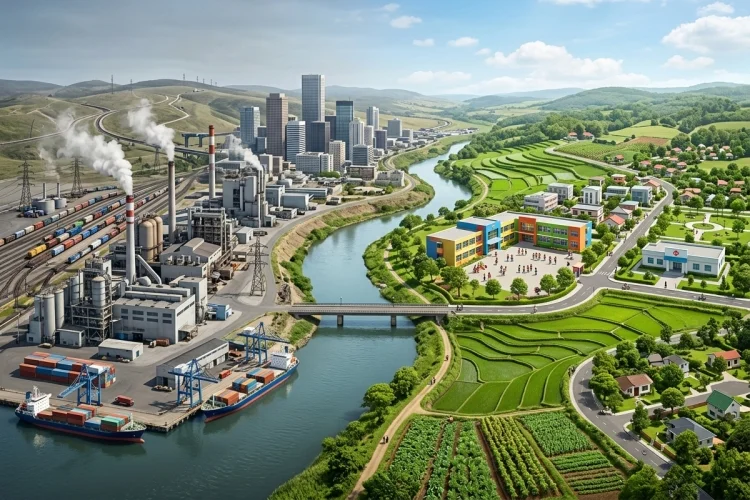
A country’s economy grows by 6%, factories produce more goods, and national income rises. That sounds like clear progress. But what if poverty remains high, schools are overcrowded, healthcare is difficult to access, and most of the additional income goes to a small group?
This is where the difference between economic growth and economic development becomes important.
Economic growth focuses mainly on whether an economy is producing more goods and services. Economic development asks a broader question: are people’s lives actually improving?
Understanding economic growth vs economic development helps explain why a rising GDP does not always lead to better living conditions for everyone.
Growth can create jobs, income, and tax revenue, but development also depends on education, health, equality, infrastructure, institutions, and environmental sustainability. The two ideas are closely connected, yet they are not interchangeable.
A country may experience rapid growth without broad development, while well-designed public policies can sometimes improve human well-being even during periods of slower economic expansion.
What Is Economic Growth?
Economic growth is an increase in the amount of goods and services produced by an economy over time. It is normally measured by the growth of real Gross Domestic Product, or real GDP.
Real GDP adjusts the value of production for inflation. This is important because nominal GDP can rise simply because prices have increased, even when an economy is not producing more.
Suppose a country’s real GDP rises from $500 billion to $520 billion in one year. Its economic growth rate is 4%.
GDP is one of the most widely used measures of economic activity because it captures the value of final goods and services produced within a country. However, it mainly tells us how much production has changed, not whether the benefits have reached different groups in society.
GDP Per Capita Gives More Context
Total GDP can grow simply because the population is increasing. Economists therefore also examine real GDP per capita, which divides inflation-adjusted output by the population.
When GDP grows by 5% but the population rises by 4%, output per person increases by only about 1%. This provides a more realistic picture of changes in average material resources.
Even GDP per capita has limitations. It is an average, so it does not reveal whether income is distributed evenly or concentrated among a small number of households.
What Is Economic Development?
Economic development is a broader process that improves people’s living standards, opportunities, capabilities, and overall well-being.
It includes higher incomes, but it also covers better healthcare, education, housing, sanitation, infrastructure, employment, personal security, and access to economic opportunities.
Development may involve structural changes as well. An economy might move from low-productivity agriculture into manufacturing, technology, or professional services. Businesses may become more productive, institutions stronger, and workers more skilled.
The United Nations Development Programme uses the Human Development Index to measure progress in three main dimensions: a long and healthy life, access to knowledge, and a decent standard of living. This illustrates why development cannot be measured through income alone.
Economic development is therefore both quantitative and qualitative. It considers not only how much an economy produces, but also what that production means for people.
The Main Difference: Output vs Quality of Life
The simplest distinction is that economic growth focuses on output, while economic development focuses on broader improvements in society.
Growth is mainly quantitative. It can be expressed through figures such as real GDP growth, productivity, national income, or output per person.
Development is multidimensional. It includes income but also examines health, education, poverty, inequality, institutions, employment quality, and environmental conditions.
Imagine two countries with the same GDP growth rate of 5%.
Country A uses rising tax revenue to improve public schools, expand healthcare, upgrade transport, and provide clean water. New jobs appear across several regions, while poverty declines.
Country B’s growth comes mostly from one extractive industry. Profits are concentrated among a few companies, local employment remains limited, and environmental damage increases.
Both countries have experienced economic growth. However, Country A has achieved broader economic development because the gains have improved people’s capabilities and living conditions.
How Economic Growth Is Measured
Economic growth is usually measured with a relatively small group of indicators.
Real GDP growth shows how much inflation-adjusted production has changed. Real GDP per capita shows how production has changed relative to population.
Economists may also examine productivity, investment, employment, industrial output, and household income. These indicators provide more detail about where growth is coming from.
Growth figures are valuable because governments need to know whether economic activity is expanding or contracting. Businesses also use them when deciding whether to hire employees, invest in equipment, or enter new markets.
However, GDP was designed to measure economic production, not complete social progress. The OECD notes that understanding whether life is improving requires a broader range of economic, social, and environmental indicators that go beyond GDP.
A rising GDP figure should therefore be treated as one part of the picture rather than a complete national scorecard.
How Economic Development Is Measured
Economic development requires a wider dashboard of indicators because it covers several dimensions of life.
Health indicators may include life expectancy, child survival, nutrition, and access to medical services. Education can be evaluated through school participation, literacy, learning outcomes, and years of schooling.
Development analysis also considers poverty rates, income distribution, employment opportunities, housing, sanitation, electricity, digital access, and environmental quality.
The Human Development Index combines health, education, and income into one summary measure. Other indicators examine gender inequality, multidimensional poverty, human capital, and access to basic services.
The World Bank’s human-capital framework connects health, education, and employment with people’s future productivity and earnings. This shows that investing in human well-being can support both development and long-term economic performance.
No single measurement can describe development perfectly. A combination of indicators is usually needed to understand whether progress is broad, inclusive, and sustainable.
Can Growth Happen Without Development?
Yes. An economy can grow rapidly without producing major improvements in living standards for most people.
This may happen when growth is concentrated in industries that create few jobs. Oil, minerals, and other natural resources can generate substantial export revenue, but the benefits may remain limited when profits are not invested in public services or productive industries.
Growth can also occur alongside rising inequality. Average income may increase while the earnings of lower-income households remain stagnant.
The World Bank’s shared-prosperity approach looks at how income or consumption grows among the least well-off parts of society. This provides more information than average GDP growth because it shows whether poorer households are participating in economic progress.
Environmental damage creates another problem. Cutting forests or exhausting mineral reserves may raise current GDP, but it can weaken the natural-resource base needed for future prosperity.
The World Bank warns that GDP does not fully capture resource depletion, pollution, or damage to human health. Strong output growth may therefore be unsustainable when it is achieved by reducing a country’s underlying wealth.
Can Development Occur Without Fast Growth?
Some development can occur even when economic growth is modest.
A government can improve public health by distributing vaccines more effectively, expanding clean-water access, or focusing resources on preventive care. Schools can improve learning through better teacher training and management without requiring enormous increases in spending.
More efficient institutions can also improve development. Reducing corruption, simplifying access to services, and strengthening legal protections may increase people’s opportunities without immediately producing rapid GDP growth.
However, development becomes difficult to sustain when an economy does not grow at all. Better healthcare, infrastructure, and social protection require workers, materials, investment, and public revenue.
Growth provides resources that can support development, while development builds healthier, better-educated, and more productive workers who can support future growth.
The relationship therefore works in both directions. Economic growth can finance human progress, while successful development can strengthen an economy’s long-term productive capacity.
Why Inclusive Growth Connects the Two
Inclusive growth aims to combine rising economic output with broad improvements in employment, income, opportunity, and well-being.
The goal is not simply to increase the size of the economy. It is to ensure that people can participate in the growth process and benefit from the results.
Policies supporting inclusive development may include quality education, healthcare, infrastructure, social protection, fair competition, access to finance, and support for workers moving between industries.
The IMF describes inclusive growth as an approach that seeks to increase national wealth and well-being while reducing poverty and supporting fairness across generations.
Job creation is especially important. Growth generated by productive employment is more likely to improve household incomes than growth concentrated in sectors with few workers.
Governments must also consider regional differences. A country can grow nationally while rural areas, former industrial regions, or poorer communities are left behind.
Sustainability Is Essential for Long-Term Development
Economic development must be sustainable if it is expected to improve living standards over many generations.
A country can expand production by using more energy, cutting forests, or extracting natural resources. Yet this approach may create pollution, climate risks, health problems, and future economic losses.
Sustainable development seeks to balance current economic needs with the protection of natural, human, and social resources.
Investment in renewable energy, efficient transport, resilient infrastructure, and responsible land use can support production while reducing long-term environmental costs.
Sustainability does not mean stopping economic activity. It means finding ways to generate income and opportunities without destroying the foundations on which future prosperity depends.
A useful development strategy therefore asks not only how quickly an economy is growing, but also whether that growth is inclusive, resilient, and environmentally responsible.
Economic growth and economic development describe different kinds of progress. Growth refers mainly to an increase in real output, usually measured through real GDP or GDP per capita.
Development includes broader improvements in health, education, opportunity, equality, institutions, and living standards. Growth can provide the income, jobs, and public revenue needed for development.
However, rising GDP alone does not guarantee that poverty will fall, services will improve, or benefits will be shared fairly. The next time you read that a country’s economy is expanding, look beyond the headline percentage.
Check whether incomes per person are rising, jobs are improving, poverty is falling, and health and education outcomes are progressing. Those details reveal whether economic growth is turning into meaningful economic development.